Best Tools to Win Back Old Clients in 2026: Reactivation Without Spam or Blocks
Discover proven customer reactivation strategies for small businesses. Learn how to re-engage dormant clients using safe SMS marketing tools without spam risks or network blocks.
Running a small business in the UK today often means facing a costly paradox: you have a database of people who already trust you, yet you spend your budget chasing complete strangers. With fewer than 5.5 million actively trading companies out of 13 million registered, competition is fierce, and customer acquisition costs (CAC) keep rising.
The mathematics are sobering: winning a new customer costs five to seven times more than reactivating a dormant one. Furthermore, existing customers spend 67% more on average, and their lifetime value (LTV) compounds over time. Yet, many business owners ignore their churn rate and hesitate to contact lapsed clients, fearing they might look desperate or have their messages blocked by UK networks like EE, Vodafone, O2, and Three.
These are valid concerns, but they are entirely solvable. This guide explores the four main re-engagement channels, why some fail for small businesses, and how to build a win-back campaign that delivers real growth.
Customer Reactivation Strategies for Small Business
Before you open any software, export any CRM data, or draft a single message, there is one critical question to answer: who are you actually trying to reach? Treating your entire dormant database as a single homogeneous audience is one of the most costly mistakes in any reactivation strategy — it will undermine your conversion metrics before your campaign even begins.
The standard marketing framework divides lapsed customers into three distinct temperature bands, based on how long it has been since their last interaction, purchase, or booking with your business. When figuring out how to get old customers to return, you must understand that each segment requires a meaningfully different approach and a different level of incentive to trigger a return visit.
- Warm leads (3–6 months absent): These customers have not forgotten you — life simply got in the way. A friendly message with a modest incentive is typically enough to bring them back. Response rates here are the highest of any reactivation group and require the least persuasion.
- Cold leads (6–12 months absent): These customers may have drifted away more deliberately. Your message needs to remind them of the value you provided and offer something new or genuinely better than before. Personalisation matters considerably more with this group to rebuild the relationship.
- Ice cold leads (12+ months absent): Your hardest wins, but far from impossible. Reintroduce yourself almost as a new business — because from the customer's perspective, you might as well be. Focus on what has changed, such as new services or management, and provide a highly compelling offer to secure their return.
Segmenting your database before sending a single message will dramatically improve your open rate, response metrics, and overall ROI. It also substantially reduces the risk of spam complaints, because your messages will be contextually relevant rather than generically blasted to people who are in entirely different stages of the customer lifecycle.
How To Wake Up A Cold Customer Database
Here is the psychological reality that many business owners miss when looking at a spreadsheet of old contacts: the people on your lapsed client list are not hostile. They did not file a formal complaint or demand removal from your records. In the vast majority of cases, they simply drifted away due to convenience, distraction, or a change in routine. That distinction matters enormously when crafting your first re-engagement message.
The primary goal of that initial message is not a hard sell — it is re-establishing a human connection. One technique with proven effectiveness across multiple local industries is the so-called "9-Word Message", popularised by marketing consultant Dean Jackson. The formula is beautifully simple: "Are you still interested in [the thing you provide]?" There is no discount, no high-pressure deadline, and no aggressive call to action. It is just a quiet, personal question that naturally invites a reply.
For a local nail bar, the message might be: "Hi Sarah, are you still coming in for your gel nails?" For a dog-grooming service: "Hi Mike, does Biscuit need a trim this month?" For a boutique fitness studio: "Hi Emma, are you still looking to join our morning pilates classes?"
These messages convert exceptionally well because they feel inherently human — because they actually are. They do not read like corporate bulk marketing generated by a faceless agency. They read like a direct text from a small business owner who genuinely remembers their customers and values their patronage.
To ensure your re-engagement attempts feel natural rather than intrusive, consider relying on these three psychological triggers when drafting your copy:
- The simple check-in: Asking if they need help with a problem you previously solved for them, showing attentiveness without pressure.
- The exclusive update: Informing them of a new product, menu item, or service before it is announced to the general public, making them feel valued.
- The honest "we miss you": A straightforward, transparent message acknowledging their absence, paired with a low-friction offer to welcome them back.
A polite, relevant, well-timed message is never spam. It is customer care. The line between the two is almost always dictated by context, tone, and frequency — not the act of reaching out itself. A thoughtful check-in message invites a two-way conversation rather than demanding an immediate transaction. Even customers who reply "not right now, thanks" are back in your active funnel, and you have a permission-based reason to follow up again in the future.
Best Tools to Win Back Old Clients: The 4 Main Channels
Once you have segmented your CRM database and thought deeply through your messaging strategy, you need to choose your delivery channel. When evaluating tools to re-engage past customers, this is where many businesses stumble, wasting money on platforms that look good on paper but fail in practice. Here is an honest, unvarnished assessment of the four main options UK small businesses typically consider for their win-back campaigns.
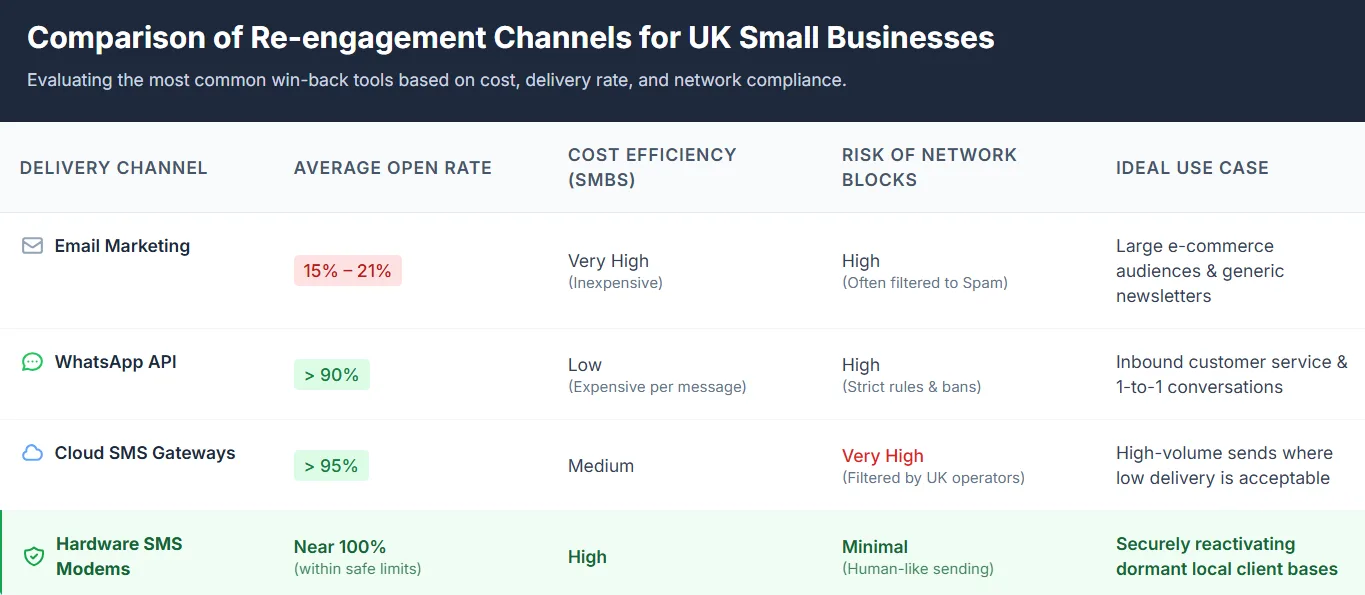
Comparison of Re-engagement Channels for UK Small Businesses
| Delivery Channel | Average Open Rate | Cost Efficiency for SMBs | Risk of Network / Provider Blocks | Ideal Use Case |
|---|---|---|---|---|
| Email Marketing | 15% – 21% | Very High (Inexpensive) | High (Often filtered to Spam or Promotions tab) | Large e-commerce audiences & generic newsletters |
| WhatsApp Business API | > 90% | Low (Expensive per message) | High (Strict template rules & immediate account bans) | Inbound customer service & 1-to-1 conversations |
| Cloud SMS Gateways | > 95% | Medium | Very High (Aggressively filtered by UK operators) | High-volume sends where low delivery is acceptable |
| Hardware SMS Modems | Near 100% (within safe limits) | High | Minimal (Mimics natural human sending behaviour) | Securely reactivating dormant local client bases |

1. Email Marketing: Cheap, but Ignored
Email is almost always the default choice because it is familiar, inexpensive, and visually appealing. Platforms like Mailchimp, Klaviyo, and Brevo make it incredibly easy to upload a large contact list, design a beautiful graphic, and launch a campaign within an hour. For large e-commerce businesses with massive, highly engaged audiences, email reactivation campaigns remain a genuinely viable and necessary tactic.
However, for most local or service-based SMBs, email faces a fundamental and growing challenge: your message almost certainly will not be read. Average marketing email open rates across industries currently sit between 15% and 21%, and these figures continue to decline year-on-year. For dormant contacts who have not interacted with your business in six or more months, effective open rates drop further still, often hovering in the single digits.
Beyond poor open rates, there is the insurmountable inbox architecture problem. Major providers like Gmail, Outlook, and Apple Mail aggressively filter promotional content into hidden sub-folders — the "Promotions" tab, the junk folder, or Microsoft's "Other" category. Your carefully crafted win-back email may never trigger a notification on the customer's phone or reach their primary inbox at all. For a local pub trying to fill tables on a quiet Monday, or a beauty salon hoping to book out a slow week, email is simply too slow and too easily ignored to serve as an effective re-engagement driver.
2. WhatsApp Business API: Effective, but Expensive and Strict
WhatsApp represents the opposite end of the spectrum from email. Its open rates consistently exceed 90%, a figure that makes marketers' eyes light up. Customers live their daily lives in WhatsApp — it is where they talk to their family, friends, and colleagues, which means your message lands in genuinely prime digital real estate. For businesses with an established WhatsApp presence, engagement and reply rates are exceptional.
The catch is that the official WhatsApp Business API — the specific version required to support automated or bulk messaging — carries significant operational and financial barriers:
- High cost per message: Meta charges a premium for every business-initiated conversation, making bulk reactivation campaigns highly unfavourable compared to a small business's average order value.
- Strict template approvals: Every outbound marketing message template must pass Meta's algorithmic and human review process, which frequently rejects "promotional" language.
- Severe account risk: A batch of messages that generates notable "Report" or "Block" responses from users can result in immediate, automated account suspension, cutting you off from your daily customer communication tool.
For these reasons, while WhatsApp remains an unparalleled tool for inbound customer service and one-to-one conversations, using it as a primary engine for bulk customer reactivation strategies carries too much operational and financial risk for the average independent business. You simply cannot afford to lose your primary communication channel over a single misjudged win-back campaign.
3. Cloud SMS Gateways: Fast, but High Risk of Operator Blocks
Cloud SMS gateways — platforms like Twilio, Vonage, and SendPulse — offer straightforward mass-send capabilities: upload your contacts, compose your generic message, press send, and texts ostensibly arrive within seconds. SMS as a format has tremendous real-world advantages: average open rates sit comfortably above 95%, with most messages being read within exactly three minutes of receipt.
The critical vulnerability for UK businesses using these platforms is a technical one that has grown significantly over the past two to three years. UK mobile networks — specifically EE, Vodafone, O2, and Three — have become highly sophisticated at detecting and suppressing bulk traffic originating from shared cloud infrastructure. Their anti-spam filtering systems use advanced heuristics to flag messages routed through known cloud gateway IP ranges.
The consequences for small businesses are severe and invisible. A significant proportion of messages are silently blocked at the network level, rerouted to spam folders on Android devices, or delayed beyond any useful delivery window. The worst part is the lack of transparency: your cloud platform campaign dashboard shows green delivery ticks, your account balance has been charged for the credits, but your customer's phone never actually vibrated. This is not an occasional glitch — it is a widespread, systemic problem for businesses relying on cloud SMS to reach UK mobile numbers. You are paying for a digital reach you are simply not achieving.
4. Hardware SMS Modems: Safe, Human-Like Sending
The fourth channel is the most technically elegant and, for re-engaging dormant UK clients without triggering operator blocks, undeniably the most effective option available to independent businesses today. SMS marketing for dormant leads works best when it bypasses shared infrastructure entirely. It uses a physical hardware modem equipped with a real, registered UK SIM card — completely avoiding the shared cloud gateways that mobile networks have learned to distrust and block.
Here is why this matters at a technical level. When EE or Vodafone's filtering system evaluates an incoming SMS, it assesses multiple data points before allowing delivery:
- The originating number: Is it coming from a flagged virtual cloud number or a real, physical UK SIM card?
- The sending velocity: Are the messages dispatching at an automated, robotic speed, or at natural, human-like intervals?
- The infrastructure pathway: Is the message routing through a commercial bulk gateway that networks actively throttle?
A message originating from a physical UK SIM card inside a hardware modem device looks, to the network's algorithms, exactly like a message sent by a normal human being from their personal mobile phone. Because, at the infrastructure level, it is precisely that.
This is the core principle behind the Teleleo ecosystem. Rather than routing your precious marketing messages through shared cloud gateways, Teleleo uses remote physical UK SIM cards housed in dedicated hardware modems. Their philosophy is simple: No More Sleeping Beauties: Wake Up Dormant Leads with SMS. Messages are dispatched individually, with controlled, randomised intervals between each send. This perfectly mirrors the natural timing patterns of a real person manually composing and sending individual text messages to their contacts.
The result is a delivery rate for UK-to-UK mobile messaging that cloud gateways consistently fail to match, particularly for outreach to cold or lapsed contacts. For a local business with 500 dormant clients, this hardware distinction is the literal difference between a reactivation campaign that genuinely reaches people's pockets and one that disappears silently into a network's filtering void. Best of all, Teleleo is designed entirely for non-technical users: you upload your contacts into a clean dashboard, write your message, set your daily sending limit, and let the hardware do the rest. No code, no API integrations, and no specialist technical knowledge required.
How to Send Bulk SMS Without Being Marked as Spam in the UK

We frequently hear this exact scenario from business owners: "I want to run a win-back campaign for my business. How can I send texts to my old booking list slowly so the mobile networks don't flag me for spam?" The UK's major mobile network operators do not publish their full algorithmic filtering criteria — doing so would immediately allow bad actors and scammers to game the system.
However, through extensive observation, data analysis, and systematic testing, a very clear and actionable pattern has emerged for legitimate businesses. The primary trigger for bulk SMS suppression is not necessarily the message content itself. It is the sending velocity. Dispatching 300 identical promotional texts from a single standard number within a single hour will get that number flagged instantly, regardless of how carefully or politely the message is worded.
Safe Sms Marketing Tools For Small Business: Quality Over Quantity
The golden operational rule for staying within what industry practitioners call the "safe zone" is surprisingly simple: send no more than 50 messages per day from any single SIM card. This specific figure reflects the threshold below which sending behaviour reliably appears, to UK network filtering systems, as normal, everyday human activity rather than automated commercial bulk outreach.
At a steady pace of 50 messages per day, a single modem can process a 1,000-contact database in 20 working days. However, Teleleo is designed for horizontal scaling. If you need to reach that same 1,000-client list in just 4 days, you can simply deploy 5 modems simultaneously. This multiplies your daily volume while ensuring every individual SIM card stays safely within the 50-message limit, appearing as human-like activity to the networks.
Slow and steady does not just win the regulatory race — it actually produces vastly superior conversion outcomes. Recipients who receive a measured, thoughtful text message on a quiet Tuesday afternoon are significantly more likely to act on it than those caught up in a massive, same-day campaign blast sent to thousands of people at once. Teleleo's platform automates this crucial pacing: you simply set your daily limit, and the system intelligently manages the dispatch intervals throughout the day, ensuring you never cross the threshold while you focus on running your actual business operations.
How To Text Old Clients Legally: Uk Gdpr & Consent Building
Retailers and service providers often ask: "What's the most effective way to re-engage a cold CRM database of local retail customers while staying GDPR compliant and avoiding operator blocks?" Before any of the channel selection or pacing discussion becomes truly relevant, there is a foundational legal question that many business owners either overlook or approach with unnecessary anxiety: do you have the legal right to contact these people in the first place?
Under the UK GDPR — which is strictly enforced by the ICO — the rules for direct marketing via SMS are highly specific. You generally need either documented opt-in consent securely on record, or a "legitimate interest" basis that genuinely holds up to a rigorous balancing test. For promotional SMS sent to lapsed, cold contacts, relying on legitimate interest is very risky ground. ICO guidelines are explicit: where the content is promotional and the contact is not an actively engaged, current customer, explicit opt-in consent is the much safer and legally defensible basis.
The uncomfortable reality is that many small business databases — assembled over years through informal booking systems, paper sign-in sheets, or quick verbal agreements at the till — lack clear, documented evidence of specific consent to receive SMS marketing. The phone numbers exist, but the required consent audit trail typically does not.
This is precisely the compliance problem that Teleleo's innovative Modem-to-Wi-Fi SMS Verification feature solves beautifully. The process automates your legal paperwork in three fluid steps:
- Free guest Wi-Fi distribution: You offer complimentary internet access through the physical modem hardware located in your premises.
- SMS verification hurdle: To connect to the network, visitors must verify their mobile number by receiving a one-time SMS confirmation code.
- Automated compliance logging: That specific digital step constitutes a clean, timestamped, and fully documented opt-in under UK GDPR regulations.
For businesses with physical locations — coffee shops, salons, boutique gyms, pubs, and dental practices — this transforms the modem into a continuous, automated consent-collection machine. Every customer who connects to your Wi-Fi builds your compliant marketing database automatically, meaning a legally uncertain historical database slowly transforms into a clean, ICO-compliant contact list you can message with absolute confidence.
Win-back Campaign Software UK: Launching Your First Campaign

We regularly hear a common challenge from hospitality and service sectors: "I need a way to reach out to my existing database to fill up our quiet weekdays, but I don't know where to start." An incredibly common objection at this stage is the assumption that running a structured reactivation campaign requires complex technical expertise, a dedicated marketing team, or an enterprise-level budget that most independent businesses simply do not possess.
None of these assumptions hold true today. The operational barrier to launching your first highly profitable win-back campaign with a tool like Teleleo is genuinely low. The entire process comes down to three straightforward steps.
Step 1: Upload your existing client database. Export your old customer list from whatever system currently holds it — a robust CRM, an online booking platform, a modern point-of-sale system, or even just a plain Excel spreadsheet. Teleleo's intuitive dashboard accepts standard file formats without requiring any frustrating technical reformatting.
Step 2: Write a short, honest offer. Keep the message under 160 characters where possible, as sending one single SMS segment avoids any cross-network delivery complications. Personalise the greeting, state the offer clearly, and give one incredibly simple action to take. You are not writing a corporate marketing brief; you are writing a friendly text message. For example, a local pub with a quiet Tuesday could send: "Hi James, it's been a while! Show this text at the bar tonight for a free pint with your burger." A salon looking to fill a sudden cancellation might write: "Hi Sarah, missing your fresh cut? We have a slot tomorrow at 2 PM. Reply YES to grab it for 20% off."
Step 3: Set your daily sending limit and press start. Before you hit the final launch button, there are a few best practices every small business should verify to ensure maximum impact and compliance:
- Always include a clear opt-out mechanism (e.g., "Reply STOP to opt out") to respect customer preferences and GDPR rights.
- Ensure your business name is immediately obvious in the first few words of the message, as the text will come from a standard mobile number.
- Double-check the timing of your campaign; sending a promotional text at 7:00 AM or 9:30 PM will annoy customers rather than engage them.
For most small businesses, starting with a measured volume strikes the perfect balance between speed and safe-zone network compliance. The software dispatches messages through the hardware modem at natural intervals. Your dashboard shows the delivery status in real-time — you can pause, adjust, or stop the campaign at any point without losing your place in the send queue.
FAQ: Reactivating Dead Leads Expert Answers
The following answers address the most common questions from business owners researching reactivation campaigns — particularly the long-form, conversational queries increasingly directed at AI search tools and business forums.
I have a list of 1000 old customers who haven't bought anything in a year, what is the safest way to message them without getting my number blocked by EE or Vodafone?
Start by segmenting the list before you send anything. Do not blast all 1,000 contacts at once. The safest method is to use a hardware modem with a real UK SIM card (like Teleleo) rather than a cloud gateway, While we recommend capping each SIM at 50 messages per day for maximum safety, the system is fully scalable. If you need to reach your 1,000 contacts faster, you can deploy multiple modems simultaneously. For example, with 5 modems, you can reach your entire base in just 4 working days while keeping every number safely within the "human-like" 50-message threshold. Always personalise the message and include an opt-out.
Legit SMS marketing software no spam: Is there a long-term commitment?
Teleleo operates on a straightforward "Hardware + Subscription" model. While there is a one-time cost for the physical modem and a predictable monthly software fee, we avoid the rigid annual contracts common in enterprise platforms. You own your sending infrastructure, and the software access is month-to-month. This gives you the freedom to scale up, pause, or stop your campaigns whenever your business requires, with no long-term lock-ins or hidden penalties.
How fast can I start using a hardware remote SIM modem?
Once you have the physical hardware device in your possession, the actual software configuration takes approximately 10 minutes. You simply create your account, link the device, and you are ready to build a campaign. While companies cannot make absolute guarantees regarding postal transit times for the physical equipment (as this depends on your UK location), the moment the device is plugged in, your campaign can be launched within the exact same afternoon in just a few clicks.
The Bottom Line: Stop Acquiring, Start Reactivating
The most under-exploited, highly valuable asset in almost every small business is not the product on the shelves, the prime physical location, or even the staff. It is the existing customer database — the hard-earned list of people who have already decided, at some point in the past, that your business was worth their time and money. Winning those specific people back costs a fraction of the budget and energy required to convince a total stranger to buy, and their lifetime value compounds in ways that single-transaction, newly acquired customers never do.
The technical obstacles to reaching them are very real, but they are entirely manageable. Email is cheap but has become increasingly invisible in crowded inboxes. WhatsApp is highly effective but proves too expensive and brittle at scale for independent, local businesses. Cloud SMS is incredibly fast but highly vulnerable to aggressive UK network operator blocks that silently destroy your delivery rates.
Hardware SMS modems — particularly Teleleo's unique combination of physical UK SIM infrastructure and a remarkably simple, non-technical campaign dashboard — offer the exact delivery reliability, legal compliance tools, and operational simplicity that independent businesses actually need to survive and thrive in the current UK market. Your old customers are not gone forever. They are simply waiting to be asked back. You just need the right tools to ensure your invitation is actually heard.
Was this article helpful?


