How a Unified Dashboard Simplifies International Team Management
Discover how a unified dashboard helps international teams centralise communication, improve visibility, streamline operations, and manage calls, messages, and employees from one platform

Managing a team spread across multiple countries is difficult enough without your tools making it harder. When your HR data lives in one system, your project tracker in another, your communication platform somewhere else, and your financial reports in a spreadsheet that nobody has quite finished updating — you spend more time chasing information than acting on it.
A unified dashboard changes that. By pulling all of your operational data into a single, coherent view, it gives managers and team leads what they actually need: a clear picture of what is happening, where, and why.
This article looks at what a centralised business dashboard actually does, why it matters for distributed teams, and how Teleleo approaches the problem.
What a Centralised Business Dashboard Means for International Team Management
A centralised business dashboard is a single interface that aggregates data from across your organisation — people, projects, communications, costs, performance — and presents it in one place. Rather than switching between eight different tools to understand what your team is doing, you open one screen.
For international teams, this is not just convenient. It is often the difference between informed decision-making and guesswork.
When your team is distributed across time zones, you rarely have the luxury of a quick meeting to sync everyone up. Decisions have to be made on the basis of data alone. If that data is scattered, incomplete, or delayed, you are making strategic choices on a foundation that does not hold. Specifically, fragmented systems tend to create three recurring problems:
- Information delays. Reports are compiled manually, which means leadership is always working from data that is already out of date.
- Conflicting versions. Different teams pull numbers from different sources, and those numbers rarely agree. Resolving the discrepancy takes time that nobody has.
- Visibility gaps. Some parts of the organisation are well-reported; others are opaque. Leaders end up making decisions with partial information and often do not realise it.
A centralised dashboard resolves all three. Everyone — regardless of location — works from the same information at the same time. A manager in London and a team lead in Singapore both see the same project status, the same resource allocation, the same flags. There is no version lag, no email chain to dig through, no uncertainty about whether the numbers are current.
That shared visibility is, in practical terms, what makes international team management workable.
Key Benefits of a Centralised Business Dashboard for Distributed Teams
The case for consolidation is not just about convenience. There are concrete operational benefits that emerge when distributed teams stop relying on fragmented tools.
- Faster, better-informed decisions. When managers have real-time data at hand, they do not have to wait for a report to be compiled before they can act. Issues surface earlier, responses are faster, and decisions are grounded in what is actually happening rather than what was happening last Tuesday.
- Reduced operational noise. A significant portion of management time in distributed teams goes towards coordination overhead — chasing updates, reconciling conflicting reports, figuring out which version of a document is current. A unified system cuts that overhead considerably.
- Consistent performance visibility. Rather than relying on each regional manager to report upward in their own format, a centralised dashboard gives leadership a consistent, comparable view of how every part of the organisation is performing.
- Lower tool costs. Most organisations running fragmented systems are paying for significant redundancy — overlapping tools that do similar things in slightly different ways. Consolidation tends to reduce software spend.
- Better compliance and security control. Managing access controls, data retention policies, and audit logs is much simpler when everything sits in a single governed system rather than being distributed across a dozen platforms with their own settings.
These benefits compound over time. The more your team grows and the more countries you operate in, the more the cost of fragmentation rises — and the more value a unified dashboard delivers.
How a Dashboard for Distributed Teams Improves Coordination Across Time Zones

Time zones are one of the defining challenges of international team management. When your team spans multiple continents, you are almost never all online at the same time. Coordination has to happen asynchronously, and that puts enormous pressure on the quality and availability of your shared information.
A dashboard for distributed teams addresses this in several practical ways:
- Persistent, real-time visibility. Because the dashboard reflects live data, a team member coming online in Sydney eight hours after their counterpart in Amsterdam last updated a project still sees the current state of things. They do not have to wait for a handover call or a morning update email. The information is simply there.
- Automated alerts. Rather than managers reaching out individually to understand what has changed overnight, the system surfaces changes proactively. If a project milestone slips, a resource is over-allocated, or a metric crosses a threshold, the relevant people are notified automatically.
- Clean asynchronous records. When everyone logs work and updates in the same system, the accumulated record is coherent and accessible to anyone who needs it, whenever they need it. The morning shift picks up where the evening shift left off, without anything falling through the cracks.
Together, these features shift the dynamic from reactive to proactive. Managers are not firefighting information gaps; they are responding to specific, identified issues. For global teams, that kind of continuity is not a luxury — it is how sustained coordination actually works.
Using a Team Communication Dashboard to Streamline Daily Operations
Communication in distributed teams tends to become complicated quickly. Different channels for different purposes, different tools preferred by different offices, conversations that should be documented getting lost in private messages. A team communication dashboard brings order to this.
The goal is not to replace communication tools but to connect them — and to surface the information that matters in context. Rather than jumping between a chat platform, an email client, a project management tool, and a video conferencing app to understand the state of a conversation, you see the relevant thread, the associated task, and the current status in one view.
This has a meaningful effect on how teams operate day to day:
- Decisions and their context are recorded and searchable, rather than disappearing into chat history.
- Team members joining a project mid-stream can get up to speed from the dashboard rather than relying on someone to brief them manually.
- Managers can see communication patterns alongside performance data — identifying, for example, whether a team that is underperforming is also under-communicating.
- Routine status updates can be automated, freeing people from having to manually report progress that the system already knows about.
The result is a team that spends less time on administrative communication and more time on actual work. Daily operations become lighter to run because the overhead of keeping everyone informed is handled by the system rather than by individuals.
Why a Business Dashboard for Remote Teams Reduces Operational Complexity
Remote and hybrid teams introduce a particular kind of operational complexity that is easy to underestimate. In a physical office, a lot of coordination happens informally — a quick question at someone's desk, a conversation by the coffee machine, a manager who can see at a glance whether a team is stretched. None of that exists when people are working from different locations, and the vacuum has to be filled somehow.
Most organisations fill it by adding more tools. A project tracker here, a time-tracking app there, a separate reporting layer on top of everything. Each addition follows a familiar logic:
- The team needs more visibility → add a monitoring tool.
- Reports are taking too long → add a reporting layer.
- Communication is getting lost → add another channel.
Each tool adds a little visibility but also adds a little friction — another login, another place to check, another data set to reconcile. Before long, the overhead of managing the tools rivals the overhead they were meant to reduce.
A business dashboard for remote teams inverts this approach. Rather than adding tools, it consolidates them. Rather than creating more places to check, it creates one. The reduction in complexity is not just administrative — it affects how decisions get made, how quickly problems are identified, and how clearly leaders understand the state of their organisation.
When all operational data flows into a single view, patterns become visible that would be invisible in fragmented systems. A region that is consistently behind on delivery timelines, a team with rising support tickets, a cost centre that is tracking above budget — these things show up clearly and can be addressed before they become serious problems. That kind of early visibility is particularly valuable for remote teams, where the natural feedback loops of a shared physical space simply do not exist.
Essential Features of an Effective Unified Dashboard for Global Companies
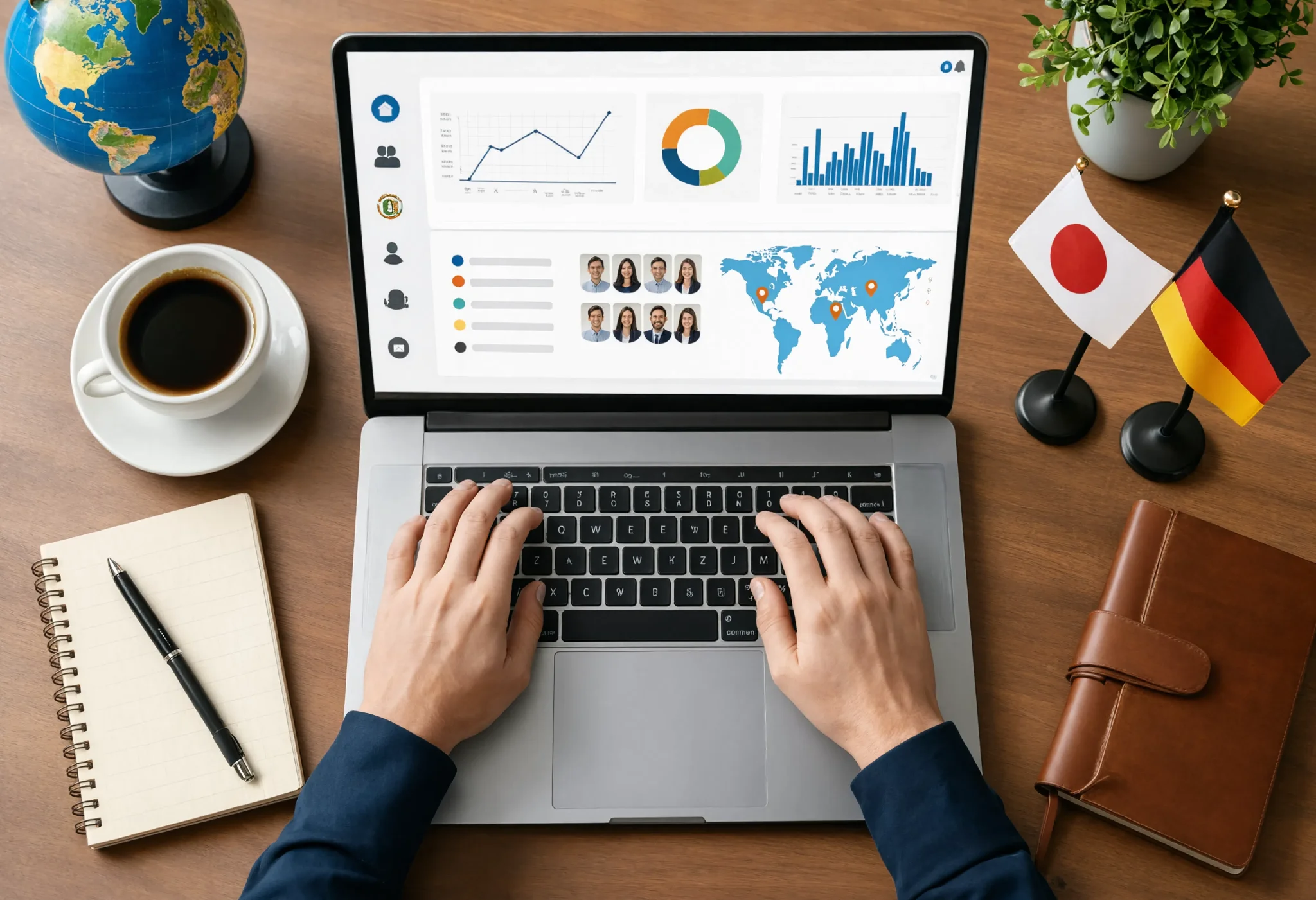
Not all dashboards are created equal. For a unified dashboard to genuinely support international team management, it needs to do more than display data attractively. The following features are what separate a useful platform from one that looks impressive in a demo but struggles in practice.
A shared number, not separate personal lines. The most common failure mode in distributed team communication is that calls and messages happen on personal phones, invisibly to everyone else. An effective dashboard is anchored to a shared company number — so that every interaction is visible, logged, and attributable, regardless of who happened to handle it.
Shared communication log. Every call and message — including missed ones — should appear in a log that the whole team can access. This creates accountability, enables seamless handovers, and gives management a complete picture of how the company communicates with its customers.
Role-based access. Not everyone needs to see everything. The ability to configure who can answer calls, who can launch campaigns, and who only views reports is essential for maintaining both security and operational clarity in a distributed team.
Automation tools for the whole team. Auto dialler, SMS campaigns, and auto-reply are most effective when they are team-level tools rather than individual configurations. When the whole team can use, see, and build on the same automation, the output is consistent rather than fragmented.
VPN for employees in restricted countries. For teams with members in markets like the UAE or China, where certain services are blocked or restricted, a built-in VPN is not optional — it is the difference between that team member being able to work normally and being cut off from company systems.
Mobile access. Distributed teams are not always at a desk. A dashboard that works only on desktop is a dashboard that stops working the moment someone is travelling, on-site with a client, or working from a different location.
Data security and compliance. For organisations handling client data across multiple countries, where data is stored and how access is controlled matters legally. A platform that stores data in a clear, governed jurisdiction and is GDPR-compliant removes a category of compliance risk.
These are not abstract requirements. They are the features that determine whether a dashboard actually changes how a distributed team operates — or just adds another screen to manage.
How Teleleo Dashboard Features Support Scalable International Team Management
Most tools for distributed teams solve the visibility problem or the connectivity problem. Teleleo solves both in a single platform — because for international teams, the two are inseparable.
The foundation is a compact modem that connects to the internet and turns a regular SIM card into a shared business number. That number becomes the centre of your team's communication, regardless of where anyone is physically located. One number, multiple people, complete visibility into everything that happens on it.
Shared company number with a team dashboard. Rather than each team member using a personal SIM, the whole team works from a single shared UK number. All calls and messages arrive in a shared log that everyone with appropriate access can see in real time. A manager in London, an accountant in Barcelona, a logistics coordinator in Shanghai — they all work from the same number, with the same information, without anyone needing to forward calls or relay messages manually.
Role-based permissions. You decide who can do what. Some team members answer inbound calls; others run outbound campaigns; others only view reports. Access is configured once and maintained centrally, with no need to manage permissions across separate tools.
Built-in VPN for restricted countries. For team members working from countries where certain services are blocked — such as the UAE or China — the built-in VPN routes their connection through a UK server. They stay on the company number, access UK services without restrictions, and their traffic is encrypted rather than exposed on local networks. This is a practical reality for any team with staff in those markets, and most tools do not address it at all.
Shared call and SMS log. Every call, every message, every missed call appears in the shared log with a timestamp and a record of who handled it. Management has complete visibility into the communication history without having to ask. If a client dispute arises, the record is there. If a new team member needs to pick up a relationship, the context is there.
Automation built into the platform. Auto dialler, SMS campaigns, and auto-reply are all available to the whole team from the same dashboard. A campaign launched by one team member is visible to everyone. Results are shared, not siloed in someone's personal phone.
No roaming subscriptions required. Team members working from abroad stay on the company's UK number over local internet — no roaming charges, no need for separate international plans, no disruption when someone moves from one country to another. One flat monthly fee covers the whole setup.
Data security aligned with UK and European standards. All calls and SMS are stored in the UK. Role-based access ensures that team members only see what they need to see. The platform is fully GDPR-compliant, with consent management, opt-out handling, and the ability to delete customer data on request.
The practical result is illustrated by the teams already using it. An accounting firm with a lead accountant in London and staff in Barcelona and Dubai routes all client calls to whoever is online, uses auto-reply during overnight hours, and has logged zero missed client calls in a month. A remote IT company with developers in Portugal, Thailand, and Ukraine offers 24/7 client support by routing calls to whichever time zone is currently daytime — without hiring night-shift operators.
This is what a genuinely unified dashboard looks like for an international team: not a reporting layer on top of existing fragmentation, but a single operational hub where communication, visibility, and team management are all the same thing.
Conclusion
International team management is genuinely hard. The time zones, the communication overhead, the fragmented tools, the difficulty of maintaining visibility across multiple locations — these are real problems that compound as organisations grow.
A unified dashboard does not solve all of them. But it removes a significant layer of complexity by ensuring that the people who need to make decisions have access to the information they need, in a form they can actually use, without having to chase it across a dozen different systems.
For distributed teams, that clarity is not a convenience. It is a basic operational requirement.
Teleleo approaches this with a platform that is built specifically around how international teams communicate: a shared company number, a shared log, role-based access, built-in VPN for restricted countries, and automation tools that the whole team can use and see. No roaming charges. No fragmented personal SIMs. One operational hub that keeps the team connected and management informed, regardless of how many countries are involved.
If your current setup involves too many tools, too many gaps, and too much time spent just figuring out what is going on — Teleleo offers a 30-day free trial. The modem is £34.99; the monthly subscription is £9.99. It is worth seeing what a genuinely unified approach looks like.
Was this article helpful?


