How to Stay Connected While Traveling in 2026: Business Communication Without Limits
Learn how to avoid roaming costs and stay connected globally. Modern business communication tools ensure secure calls, OTP delivery, and full control over your corporate number
Modern Business Communication in 2026: Solutions for Remote Work and Travel
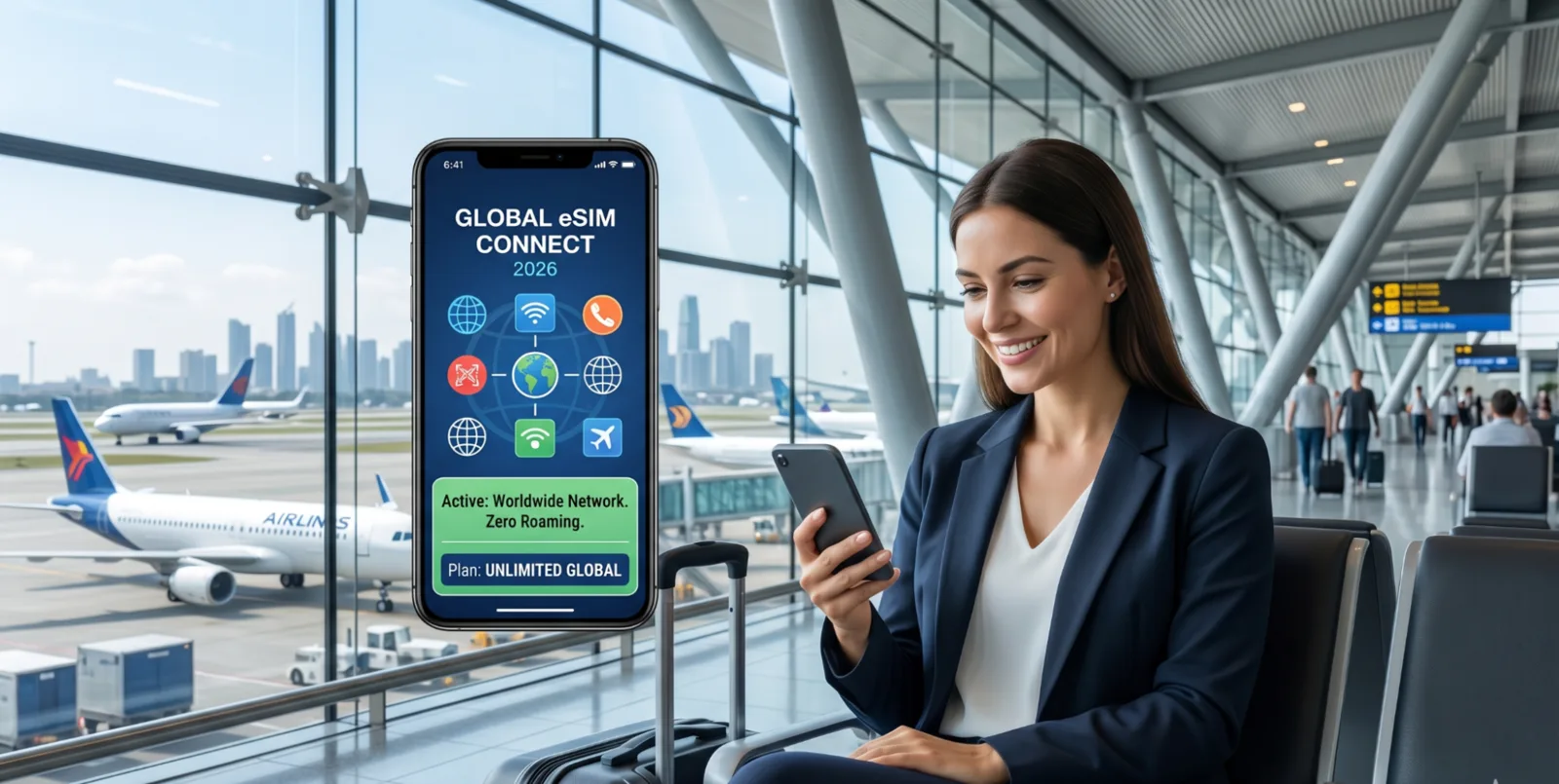
In 2026, the distributed work model has become the absolute standard of corporate culture. However, despite the rapid evolution of IT, maintaining reliable communication for business during travel still requires significant investment. Traditional international roaming is draining corporate budgets at an alarming rate, and losing access to a "home" SIM card while abroad can bring operations to a complete standstill.
Critical Risks of Losing Your Primary Number:
- Inability to receive SMS codes required to authorize sensitive banking transactions.
- Severed direct contact with key partners and major stakeholders.
- Paralysis of internal workflows and approvals within a distributed office.
Fortunately, hardware solutions like those offered by Teleleo provide a powerful alternative. The era of overpaying mobile operators is giving way to sophisticated hardware that ensures seamless access to corporate infrastructure from anywhere in the world, shielding teams from unexpected blocks and high costs.
How Business Connectivity Requirements Have Evolved in 2026
In the B2B sector, the approach to building IT infrastructure has shifted dramatically. The days of juggling dozens of fragmented apps are over, replaced by fault-tolerant ecosystems. When deciding which services a remote team needs to stay productive, leaders now prioritize autonomy and high-level security.
Modern tools for communication within a distributed team must strictly adhere to new corporate benchmarks:
- Deep Data Protection: End-to-End encryption (E2EE) is now the mandatory baseline, preventing the theft of trade secrets over public Wi-Fi during business trips.
- Infrastructural Independence: Business processes shouldn't fail due to poor local coverage or regional digital blocks.
- Stable 2FA Reception: Without the reliable delivery of one-time passwords (OTP) for CRMs and banking, connectivity for employees working remotely becomes virtually useless.
Maintaining reliable client communication when working outside the office in 2026 requires a closed, protected environment. In such a setup, your primary business number remains active, and financial data is isolated from the vulnerabilities of foreign networks.
Methodology: How We Ranked the Leading Solutions
To objectively identify the top-tier services for online business communications, we relied on rigorous IT metrics rather than marketing promises. In analyzing how to establish stable communication with your remote team, we applied a comprehensive evaluation framework.
Hardware and software platforms were selected based on five key pillars:
- Financial Transparency: Zero hidden fees or unpredictable "bill shocks."
- 2FA Stability: Guaranteed instant delivery of banking OTPs without being flagged by anti-fraud systems.
- Team Access: The technical ability to share a single corporate number among multiple department members seamlessly.
- Encryption Standards: Robust cryptographic protection against interception in guest networks.
- Network Autonomy: Operating independently of the quality or restrictions of local cellular providers abroad.
This strict filtering process highlights the best services for remote work communication, effectively filtering out amateur B2C products.
Comparison Matrix: Teleleo vs. Roaming vs. VoIP
When considering how to stay in touch with a team remotely or while on the move, it becomes clear that most popular tools only solve part of the puzzle. Video conferencing is great for meetings, and eSIMs provide cheap data, but neither replaces full-featured GSM connectivity.
The following table illustrates the technological gap between the modern tools for business communication during travel and traditional methods.
| Evaluation Criterion | Traditional Roaming | Travel eSIMs | Video Conf. (Zoom/Teams) | VoIP / SIP Numbers | Teleleo |
|---|---|---|---|---|---|
| Keep Existing Number | Yes | No (Data only) | No | No (New number) | Yes |
| 100% Bank SMS Delivery | Yes | No | No | No (Risk of block) | Yes (Guaranteed) |
| Receive "Cold" GSM Calls | Yes | No | No (Link only) | Yes | Yes |
| Team Access to Number | No | No | Yes | Yes | Yes |
| Pricing Policy | Hidden fees | Per GB | License fees | Per min + number | Fixed Tariff |
Legacy Tools: Why Video Conferencing, SIP, and eSIMs No Longer Cut It
When analyzing which specific services help stay connected while traveling on business, companies often follow the path of least resistance by sticking with familiar software. However, corporate reality in 2026 proves that this classic tech stack has critical systemic vulnerabilities. Let’s dive into why these popular tools for remote team communication are consistently failing the distributed office and forcing a search for alternatives.
Video Conferencing (VC) and Corporate Messengers
Platforms for video meetings and encrypted work chats handle internal tasks brilliantly. If you need to run a sprint sync or share project files, they are an excellent choice.
However, when you need to communicate with clients while working remotely on a daily basis, VC systems show their weakness. They face two fundamental infrastructure hurdles:
- Isolation from Cellular Networks: Clients can’t just dial an employee’s familiar mobile number. They have to click links, wait for invites, or install third-party apps. For sales teams, this is a major friction point.
- Lack of SMS Support: No corporate messenger can receive classic service messages. A specialist on a business trip won't be able to receive a bank authorization code or recover access to a cloud-based CRM.
Ultimately, when deciding how to communicate with a remote team while traveling, leaders often accidentally create a functional but isolated information bubble. It solves internal issues but cuts the professional off from traditional telephony and the financial sector.
Virtual Numbers (VoIP) and Travel eSIMs: The Hidden Threats
In the quest for how to ensure stable communication while traveling at a minimal cost, virtual IP numbers and travel eSIMs often take center stage. On the surface, they seem logical: low cost per minute and cheap local data are tempting. But 2026 has revealed risks that cost far more than the savings.
The main issue with VoIP is reputation. Major financial institutions and government services have aggressive anti-fraud policies. Since virtual numbers can be registered en masse and are often used for spam, bank security algorithms frequently "grey-list" them.
Critical drawbacks of virtual numbers include:
- Blocked OTP Messages: Transaction confirmation SMS often never reach IP numbers. This instantly paralyzes accounting and top management operations abroad.
- Low Client Trust: Incoming calls from unknown IP ranges are often flagged as "Spam" or "Fraud" by smartphones, tanking sales efficiency.
The situation with travel eSIMs is equally tricky. They provide gigabytes at local prices, but the primary business communication for travel (your main number) remains tied to a physical SIM. To avoid missing important calls, the user keeps their "home" SIM active, which triggers the international roaming clock. The "savings" on internet are instantly wiped out by massive bills for incoming calls and background system updates.
Consequently, when choosing communication services for a distributed office, businesses fall into a trap: either cheap data with "golden" call rates (eSIM) or total isolation from banking systems (VoIP). These are no longer professional standards for 2026.
Teleleo: The Hardware Revolution in Corporate Connectivity

Against the backdrop of VoIP limitations and roaming costs, autonomous technological ecosystems have moved to the forefront in 2026. The Teleleo solution represents a fundamentally different way to set up corporate communication for remote work. The core concept is simple: severing the physical link between the user and their SIM card.
How it works technically:
- Local Placement: Your physical SIM card stays in its home region, plugged into a proprietary Teleleo modem.
- Always Online: The device is connected to power and the internet, keeping the SIM card in its "home" cellular network 24/7.
- Remote Control: From anywhere in the world, the user logs into the platform via laptop or smartphone to access all SIM functions.
This architecture legally bypasses international billing. To the carrier, the subscriber never left home, meaning all incoming calls and SMS are free or billed at local rates. This makes it a vital communication tool for a distributed team that demands stability without overpaying.
5 Reasons Teleleo Outperforms Roaming and SIP
An analysis shows this hardware complex covers the "blind spots" that traditional providers have ignored for years. Here is why it is becoming the standard for modern business communication tools for travel.
Zero Roaming Costs While Keeping Your Number
The biggest barrier to business communication for travel is unpredictable expenses. Traditional roaming charges you for every action. Teleleo flips this by offering a fixed, transparent cost of ownership.
- No International Billing: Since the SIM stays home, the carrier treats all activity as local.
- Fixed Subscription: Instead of variable costs, the company has a predictable expense (starting from £9.99/mo), easy to fit into a distributed office budget.
- No Number Swapping: You don’t need to buy new SIMs in every country or pay for expensive international corporate packages.
Reliable OTP and 2FA for Business
In 2026, identity verification is everything. Most top services for online business communications require one-time passwords (OTP).
- Home Network Advantage: Because the SIM is in its native coverage zone, 100% SMS delivery is guaranteed.
- Instant Sync: Authorization codes appear in your secure dashboard immediately.
- Zero Downtime: This is the only way to ensure stable communication with a remote team where financial transactions don't depend on the quality of foreign roaming.
Shared Access: One Number for the Whole Team
A major pain point for distributed team communication has been tethering a corporate number to a single physical phone. If that person is OOO, the link to the client breaks. Teleleo introduces Contact Management:
- Collective Use: Multiple specialists can log in and use one SIM's resources simultaneously.
- Centralized Control: Managers can track incoming history and ensure no client request is ignored.
- Seamless Handoffs: As one manager ends their shift in one time zone, another picks up the conversation using the same number the client recognizes.
Automation: USSD, Auto-Replies, and Integrations
Manual communication management is an archaism. Teleleo acts as a mini-PBX, which is exactly what communication services a remote team needs for professional-grade work.
- Remote USSD: Check balances or change plans via the interface without touching the SIM.
- Smart Auto-Reply: Handle incoming calls automatically during off-hours or across time zones.
- SMS Integration: Forward messages to email or corporate messengers like Slack or Teams automatically.
An "All-in-One" Ecosystem and Independence
In 2026, versatility is king. This hardware solution is more than a gateway; it's a comprehensive toolkit for corporate connectivity for remote employees:
- Wi-Fi Hotspot: Provides a backup connection for office peripherals.
- Autodialer: Tools for mass notifications and rapid client updates.
- Local VPN: Secure access to home network resources from any location.
By integrating these features, Teleleo provides the best communication services for remote work, ensuring that communicating with clients when working outside the office remains as professional and reliable as being in a headquarters.
Guide: How to Deploy a Remote Communication Node Before Your Trip

To maintain reliable business communication during travel, companies no longer need to hire a fleet of system administrators or purchase expensive server racks. Modern hardware solutions are designed with a "Plug-and-Play" philosophy. Setting up your own personal communication node takes minutes and requires zero specialized technical skills.
Connection Steps
In 2026, preparing for a trip and configuring business communication for travel and remote work has been simplified to a few logical steps:
- Ordering Equipment: First, you order the proprietary modem. Thanks to global logistics, the device is delivered anywhere in the world rapidly, allowing you to equip a distributed office with the necessary hardware on short notice.
- Preparing the SIM Card: You insert a standard "home" SIM card with your existing corporate plan into the device. It’s important to ensure the card has a signal and a positive balance for its home network.
- Connecting to Infrastructure: The modem is plugged into a power source and your home internet (via Wi-Fi). From this moment, the physical card stays in a safe location, while its management moves into the digital space.
- Activation and Testing: You register an account and activate a 30-day free trial. This is the perfect time to see what services help you stay connected while traveling by testing calls and SMS without any financial commitment.
Following this sequence ensures that by the time you board your flight, you have a fully verified and ready-to-use line. This eliminates the panic of hunting for local SIMs at the airport and allows you to immediately jump into workflows while communicating with clients when working outside the office.
Boundless Connection as the 2026 Standard
In 2026, a person's geographic location is no longer a valid excuse for high operational costs or a drop in client service quality. The technological barrier between "home" networks and international space has been permanently dismantled. There is simply no economic reason to overpay for roaming or risk the security of financial transactions on questionable virtual numbers.
Modern corporate connectivity for remote employees is built on three pillars:
- Total autonomy from foreign mobile networks;
- Guaranteed delivery of critical service messages;
- Transparent budgeting for all communication expenses.
For those looking for how to establish stable communication with a remote team and maintain seamless client contact, Teleleo’s hardware solution is the gold standard. It’s an investment in the predictability and reliability of your business. Don't wait until the last minute before your flight—order a device with global delivery today and experience the benefits of the best communication services for remote work with a 30-day free trial.
FAQ: Frequently Asked Questions About Using Teleleo Remotely
Is it safe to receive banking OTP codes through the platform?
This is a common concern when using digital intermediaries. Teleleo uses strict security protocols to ensure communicating with clients while working remotely remains secure:
- End-to-End Encryption: All data between your modem and your device is transmitted through an encrypted channel.
- Zero Storage Policy: The platform acts only as a technical bridge. SMS and call logs are not stored on the servers, eliminating the risk of leaks. Confidential info, like bank codes, remains accessible only to the SIM owner.
What happens if the power or internet goes out at my home office?
Teleleo is a physical device, so it depends on the local infrastructure where it’s installed. If the power or internet drops at the home location, the connection will be temporarily interrupted. To keep staying in touch with your remote team consistent, we recommend:
- Using an Uninterruptible Power Supply (UPS) for the modem.
- Connecting the device to the most stable internet line available. These small steps ensure you stay communicating with clients while working remotely even during local technical hiccups back home.
Do I need a special SIM card for the modem?
No. This is a common misconception. To set up corporate communication for remote work, you don't need any new contracts. You use your existing, familiar SIM card that is already linked to your business contacts and banks. Your current tariff remains active, avoiding bureaucracy and extra costs.
Does audio quality drop or is there high "ping" when calling from abroad?
Voice stability is vital for communication tools for a distributed team. The Teleleo platform is optimized for unstable networks:
- Latency Minimization: The architecture fights "ping" effectively to eliminate echoes.
- Low Bandwidth Requirements: Standard hotel Wi-Fi or a steady 4G signal is enough for clear voice transmission. This ensures your modern business communication tools for travel work correctly even in countries with developing digital infrastructure.
Can I set up authorization code forwarding for the whole team?
Teamwork is where Teleleo shines. The "Redirection" feature lets you flexibly forward SMS:
- To corporate email;
- To team messengers like Slack or Telegram.
This allows accounting and support teams to get in touch with a remote team's resources, seeing confirmation codes from a single number simultaneously. This level of business communication for travel keeps everyone in sync and prevents payment delays.
Was this article helpful?


