Emigrating from the UK to the UAE in 2026: Visas, Taxes, and Retaining Your UK Digital Infrastructure
Learn the cheapest and safest ways to use your UK phone abroad long term, avoid hidden roaming costs, receive home alarm SMS abroad, and maintain secure access to UK banking and 2FA without relying on VoIP numbers

Emigrating from the UK to the United Arab Emirates in 2026 means managing three parallel projects at once: securing the right residency pathway, restructuring your tax position under new UAE and UK regulations, and maintaining digital continuity with the British services you still depend on. Each has become significantly more complex — and more consequential — than just a few years ago.
The UAE remains the dominant destination for British entrepreneurs, consultants, and finance professionals seeking to restructure their lifestyle and tax position. Yet, while the appeal of zero personal income tax is obvious, the administrative reality is demanding. Losing access to your UK phone number mid-relocation to Dubai or Abu Dhabi can now lock you out of your UK bank account, your HMRC portal, and your property management apps simultaneously — a risk most people discover only after they have boarded the flight.
This guide covers the ground that matters for British nationals moving to the Emirates: which visa routes are viable in 2026, how remote work and corporate taxes operate in practice, and how to protect your UK digital infrastructure before you leave — whether you are relocating a family or going solo.
The UAE Immigration Landscape: Visas for Remote Workers and Founders
Immigration policy in the UAE has evolved from a strict employer-sponsored model to a highly flexible, talent-driven framework. For British nationals, understanding precisely which route aligns with your income source and long-term goals is the foundation of a successful relocation.
The Virtual Working Programme (Digital Nomad Route)
For UK professionals employed by a British company or running a UK-based business, Dubai's Virtual Working Programme is the most streamlined entry point. Valid for one year and renewable, it allows you to reside in the UAE whilst continuing to work for your overseas employer. The primary requirement is proof of employment and a minimum monthly income (currently set at $3,500 or equivalent in GBP). Crucially, this visa does not allow you to work for a local UAE company, keeping your employment ties firmly in the UK.
Green Visas and Freelance Permits
For independent consultants and sole traders, the Green Visa provides a five-year residency track without the need for a corporate sponsor. To qualify, you must obtain a freelance permit from the Ministry of Human Resources and Emiratisation (MOHRE) and demonstrate a bachelor's degree alongside a minimum annual income from self-employment. This route has become exceptionally popular for British consultants in tech, media, and advisory roles who want long-term stability without establishing a full corporate entity.
The Golden Visa and Free Zone Company Formation
The Golden Visa remains the premier tier, offering 10-year renewable residency. While property investment (minimum AED 2 million) is a common route, British tech founders, doctors, and highly skilled specialists frequently qualify under the exceptional talent categories.
Alternatively, setting up a Free Zone company (such as in DMCC or ADGM) provides both a trading licence and a pathway to an investor residency visa. Free zones allow 100% foreign ownership and provide a robust legal framework based on English common law, making them highly attractive to UK business owners looking to shift their primary operations to the Gulf.
Navigating the Tax Reality: HMRC and the UAE Corporate Tax

The assumption that moving to Dubai eliminates all tax complexity is a dangerous misconception in 2026. The interaction between UK non-residence rules and the UAE's maturing tax environment requires proactive management.
UK Statutory Residence Test and HMRC
Personal tax residency is not determined simply by boarding a plane. To eliminate UK income tax on your earnings, you must satisfy the conditions of the UK Statutory Residence Test (SRT) and officially become a non-UK resident. HMRC scrutinises these claims rigorously. The obligation to notify HMRC of your departure (via Form P85 or Self Assessment) is not discretionary. Failing to formally break UK tax residency means HMRC can, and will, continue to assess you on your worldwide income. Furthermore, any income generated from UK property rentals remains taxable in the UK regardless of your UAE residency.
UAE Corporate Tax (9%) and Permanent Establishment
The most significant shift for business owners relocating to the Emirates is the introduction of the UAE Corporate Tax. A standard rate of 9% now applies to taxable corporate profits exceeding AED 375,000. While Free Zone companies can often claim a 0% qualifying rate, this depends entirely on the nature of their income (Qualifying Income) and strict substance requirements.
There is also a severe risk for UK employers allowing staff to work from Dubai. If you continue working remotely for a UK employer whilst physically located in the UAE, you may inadvertently create a "permanent establishment" of that UK company in the Emirates, potentially triggering UAE corporate tax obligations for your British employer. This is why many UK firms now require employees to restructure as independent contractors before approving long-term overseas relocation.
Technical and Financial Readiness: How to Avoid Losing Access to Services
If there is one section of this guide that experienced relocators to the Gulf consistently cite as underplanned, it is this one. The legal dimensions of emigration to the UAE are widely acknowledged as complex. The digital infrastructure dimension tends to be treated as an afterthought — until the morning your UK bank locks your account because it cannot deliver a one-time passcode to your new Etisalat or Du number.
The 2FA problem and its cascade effect
Two-factor authentication has become the universal security standard for financial services, government platforms, and commercial accounts. Your UK bank account, your HMRC Government Gateway login, your NHS app, your National Insurance correspondence, your Amazon delivery phone number verification — all of these rely on sending an SMS or placing a call to a specific UK mobile number.
The problem for British expats in the UAE unfolds in stages. If you take your UK SIM to Dubai, you incur aggressive roaming charges. More significantly, many UK banks and government services now actively filter out international numbers and eSIM-based travel numbers from their OTP delivery systems as a fraud prevention measure. Receiving HMRC texts abroad becomes unreliable in ways that are difficult to diagnose. And if you cancel your UK SIM to save money, the consequences cascade across every account linked to that number.
Can you keep your UK bank account if you move to Dubai? Generally yes, provided you can demonstrate a continuing UK contact number that reliably receives SMS. Managing UK property from overseas adds a further layer: letting agents, mortgage providers, and maintenance contractors all generate authentication challenges that flow to a UK number. How to keep your UK mobile number active in the Middle East is therefore an operational question, not a preference.
Connectivity Solutions Rated: How to Keep Your Home Number in 2026
There are several broad approaches to maintaining a UK number whilst abroad, each with material differences in reliability, cost, and security. The criteria for evaluation are: OTP and SMS delivery reliability; long-term cost over twelve or more months; security against interception and fraud; ease of setup; and whether business features such as team access or autodialer are supported.
The table below compares the four main solution categories:
| Solution Type | OTP/SMS Reliability | Ongoing Cost | Security | Setup | Business Features |
|---|---|---|---|---|---|
| Standard roaming (SIM abroad) | Moderate — foreign network delivery not guaranteed | High — per-SMS and per-call charges | Moderate | None | None |
| eSIM on dual-SIM device | Low — many UK banks reject eSIM numbers for OTP | Low to moderate | Moderate | Simple | None |
| VoIP / virtual number service | Low — blocked by most UK banks and HMRC | Low | Low — shared infrastructure | Simple | Limited |
| Cloud GSM modem (e.g. Teleleo) | High — genuine SIM on UK network | Low — one-time hardware plus subscription | High — encrypted, dedicated hardware | Low — one-time setup | Strong — team access, autodialer, SMS forwarding, campaigns |
The table reveals a structural problem with the most widely adopted solutions. Standard roaming is expensive and increasingly unreliable for high-security SMS. eSIM numbers are actively screened out by UK financial institutions. VoIP virtual number services — widely marketed as the best virtual phone number UK solution for expats — are categorically unsuitable for banking OTPs or HMRC texts, because most platforms now verify genuine UK network registration, and a virtual number fails that check.
The fourth category is architecturally different, and this is where Teleleo operates.
Why Teleleo Has Become the Standard for Relocators in 2026
The logic behind Teleleo is straightforward: rather than replicating a UK number in software or keeping a SIM roaming on a UAE network, you leave your SIM where it works — in the UK, inside a dedicated hardware modem — and access it remotely through an encrypted cloud interface from your Dubai apartment or Abu Dhabi office.
When your UK bank sends an OTP, it is delivered to your actual SIM card on your actual UK network. When HMRC sends a verification code, it arrives on the number originally registered to that account. The difference between this and a VoIP or eSIM workaround is the difference between genuine UK presence and a simulation of one. Banks and government systems can distinguish between the two, and increasingly, they act on it.
With an active subscription, the Teleleo platform enables two-way SMS, voice calls via the Teleleo mobile app or third-party SIP applications such as Zoiper or Linphone, SMS forwarding to email or Telegram, and autodialer. For businesses managing client communications internationally, the ability to share a single SIM's access across a distributed team represents a meaningful operational upgrade. The security model is equally robust: because Teleleo uses your own SIM on your own UK network, there is no shared number pool and no foreign carrier routing. All communication between the modem and cloud platform is encrypted.
The modem hardware costs a one-off £34.99, with your chosen subscription tier charged separately. Setup requires no technical expertise — insert your SIM, connect to power at your UK address before you depart, and log in from wherever you are in the UAE. For avoiding international roaming charges whilst retaining full UK connectivity, it is the most robust solution available to UK expats.
Life After the Move: Family, Solo, and Social Integration in the UAE
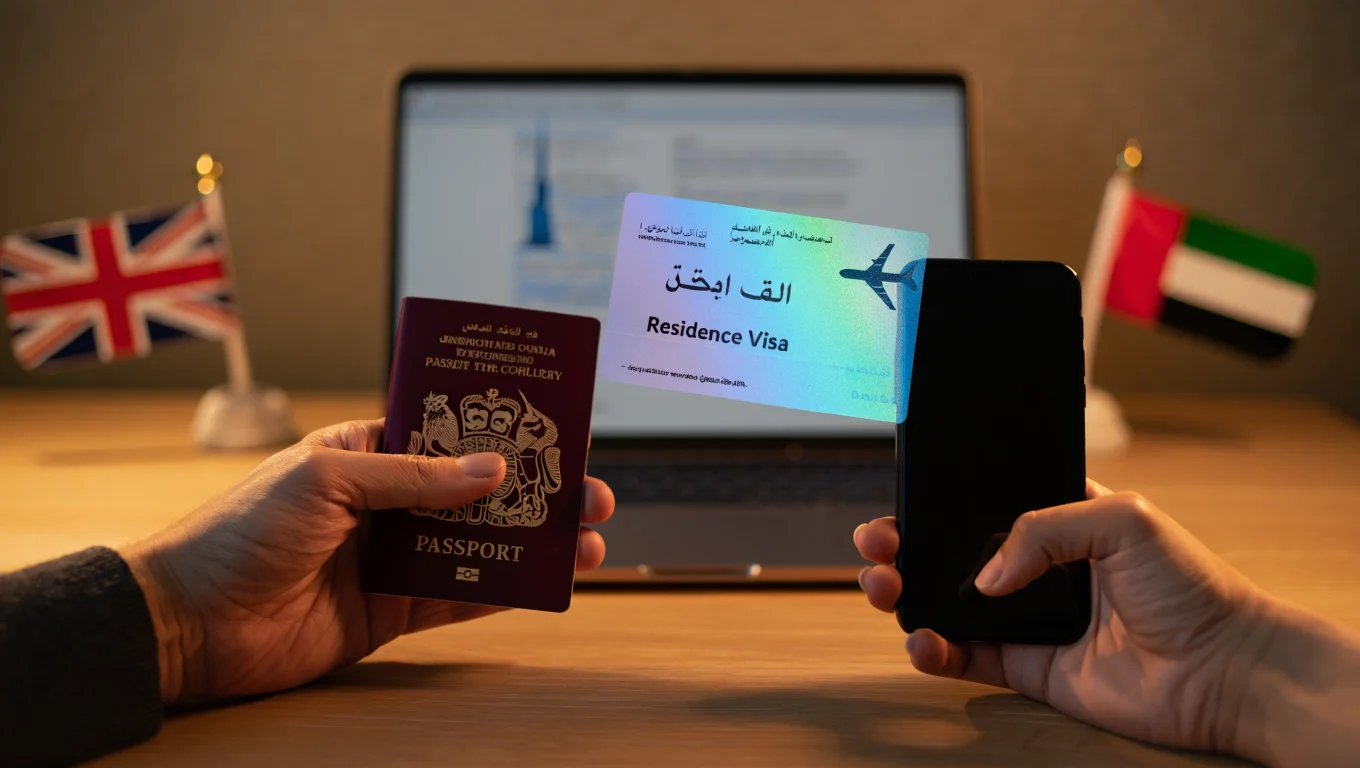
The logistics of relocation consume most pre-departure planning energy. What tends to be underestimated is the challenge of actually building a life in the UAE — and this varies substantially depending on whether you are moving alone or with a family.
Solo relocation: speed, flexibility, and the networking imperative
The solo relocator has genuine advantages in pace. Processing an Emirates ID and securing a residential lease in areas like Dubai Marina or JLT can be done in a matter of weeks. The central challenge is social infrastructure. Co-working spaces and professional hubs in DIFC or Media City have become the primary social entry point for solo remote workers. For those continuing to serve UK clients from these hubs, having your UK number fully operational through Teleleo means clients reach you on a familiar number with no visible change, which matters particularly for consultants for whom consistent contact details carry professional weight.
Family relocation: the complexity multiplier
Moving abroad with a family checklist must account for variables well beyond the relocating individual's own documentation.
Schooling is the largest hurdle. Dubai and Abu Dhabi boast excellent British curriculum schools, but they are frequently oversubscribed and subject to strict KHDA (Knowledge and Human Development Authority) ratings and fee structures. The application process needs to begin six to twelve months before departure.
Healthcare requires dedicated planning: mandatory private health insurance must be in place to secure your UAE residency visa. Meanwhile, retaining the NHS app abroad presents a specific challenge for families seeking to maintain access to UK health records. The app requires periodic re-authentication via SMS to a UK mobile number. Families who have allowed UK SIM numbers to lapse often find themselves locked out of health records when trying to share medical history with UAE doctors.
Partner legalisation adds a further dimension. If you sponsor your spouse, they receive a residency visa, but working requires an additional work permit from MOHRE. Understanding this before departure determines whether a dual-income household is feasible from the outset.
Checklist: 10 Steps to a Successful UAE Relocation in 2026
Work through these steps in sequence, not in parallel — each carries dependencies that compress timelines when left to the final weeks.
- Define your UAE legal pathway. Identify whether a Virtual Work Programme, Freelance Green Visa, or Free Zone company formation best suits your income structure.
- Audit your tax residency position. Take professional advice on the UK Statutory Residence Test and officially notify HMRC of your departure.
- Secure your banking continuity. Notify your UK bank; set up a multi-currency digital account (like Monzo or Revolut) as backup; prepare documents for a UAE account (like Emirates NBD or Wio).
- Protect your UK phone number before you leave. Arrange a permanent solution — such as Teleleo's cloud GSM modem — and plug it in at a UK address before boarding your flight.
- Check your National Insurance record. Review your NI contribution history and consider voluntary contributions to protect your UK state pension entitlement.
- Plan accommodation in stages. Secure short-term rental (e.g., a hotel apartment) first; commit to a yearly Ejari (tenancy contract) only after securing your Emirates ID.
- Begin children's school applications early. Target KHDA-rated schools six to twelve months before departure and budget for registration fees.
- Obtain comprehensive international health insurance. This is a mandatory prerequisite for your UAE visa stamping.
- Complete your Emirates ID processing. Prioritise your medical fitness test and biometrics immediately upon arrival, as no long-term contracts can be signed without the ID.
- Register with the British Embassy. Use the FCDO's LOCATE service to register your presence in the UAE — it takes five minutes.
FAQ: Frequently Asked Questions
Can I work remotely on a UAE tourist visa in 2026?
The legal position is strict. The UAE prohibits formal employment on a standard tourist visa. If you intend to work remotely for more than a few weeks, the Virtual Working Programme (for employees) or a Freelance permit (for sole traders) is the appropriate, legally compliant solution.
Which banks in the UAE are most accessible to new British residents?
Digital-first banks like Wio and Liv (by Emirates NBD) are generally the fastest for new residents, often allowing account opening via an app once your Emirates ID is issued. Traditional banks like Emirates NBD, ADCB, and HSBC UAE offer robust premium banking services but require physical presence and salary certificates for onboarding.
Why has my UK bank stopped sending SMS to my UAE number or eSIM?
UK banks and government services including HMRC have progressively filtered out international, virtual, and eSIM numbers from their OTP delivery systems as a fraud prevention measure. These systems verify genuine UK network registration, and a roaming Etisalat/Du eSIM or VoIP number does not pass that check. Teleleo solves this by keeping your physical SIM in the UK, active and accessible via the cloud.
How do I avoid double taxation between the UK and UAE?
The UK and UAE have a Double Taxation Treaty. However, because the UAE does not levy personal income tax, the primary concern is ensuring you successfully break UK tax residency via the Statutory Residence Test. If you remain a UK tax resident, HMRC will tax your UAE earnings. Professional tax advice is strongly recommended.
Do I need to notify the tax authority in my home country when I move to Dubai?
Yes. You must complete form P85 or notify HMRC through your Self Assessment return. Failure to do so means HMRC may continue assessing you as UK-resident. If you retain UK property, you must also register under the Non-Resident Landlord (NRL) scheme.
What is the main difference between a Free Zone Visa and the Virtual Work Programme?
The Virtual Work Programme allows you to live in the UAE whilst being employed and paid by a UK company. A Free Zone Visa requires you to incorporate a new corporate entity in the UAE, which serves as your sponsor. Free Zone setup carries higher initial costs and regulatory obligations but allows you to trade locally and internationally as a UAE business.
Is it safe to use cloud GSM modem solutions such as Teleleo?
Yes — and from a security standpoint, they are significantly safer than the alternatives most expats rely on. With Teleleo, your SIM card remains in hardware you own, on a UK network, with encrypted communication to your dashboard. There is no shared number pool and no routing through foreign carrier infrastructure. For expats handling UK banking authentication and HMRC correspondence, the security case for a dedicated home modem solution is clear.
Was this article helpful?


